
Interoperability and standards
By the end of this module you will be able to:
- Distinguish semantic from syntactic interoperability with a healthcare example
- Explain the role of RDF triples in linked data
- Describe a real-world knowledge graph application
- Identify the correct NHS standard for clinical terminology interoperability
Why interoperability needs syntactic and semantic layers
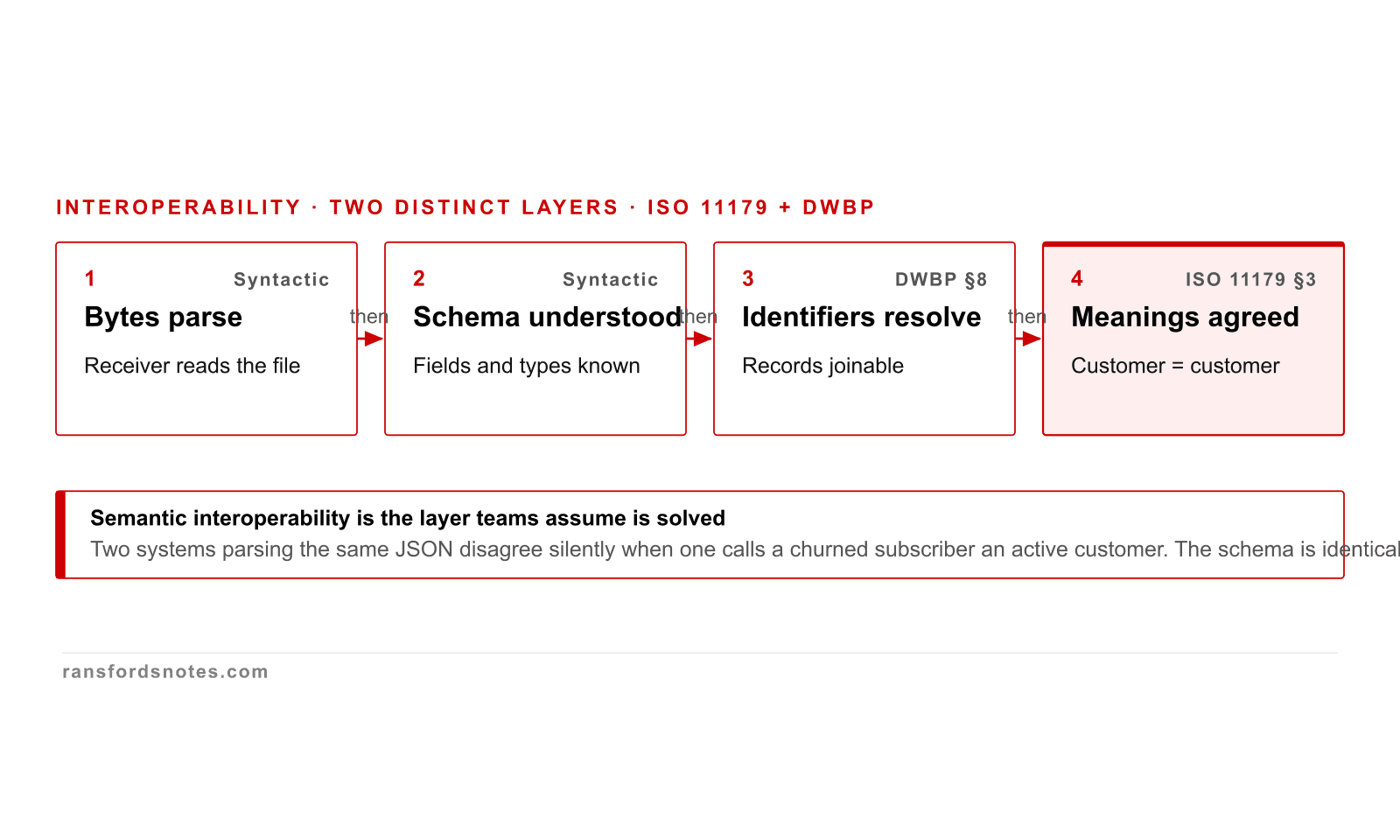
Interoperability has two distinct layers: syntactic (bytes parse) and semantic (meaning agreed).
Interoperability has two layers, not one. Syntactic interoperability means the receiver can parse the bytes; semantic interoperability means the receiver and sender mean the same thing by customer. ISO/IEC 11179-1:2023 §3 separates the two; W3C DWBP §10 mandates a shared vocabulary for semantic alignment.
Five binding clauses every API contract should carry
An API contract binds five clauses: endpoint, schema, error model, rate limits, deprecation policy.
An API contract binds the provider to the consumer in five clauses: endpoint, schema, error model, rate limits, deprecation policy. OpenAPI 3.1 carries the first three machine-readably; ODCS v3.1.0 adds the operational ones.
Real-world challenge · ongoing
Two hospitals share patient data. The same drug has two different codes.
When two NHS hospitals share patient data, both systems can exchange XML or JSON messages (syntactic interoperability). But if Hospital A codes paracetamol as "N02BE01" (ATC classification) and Hospital B uses a proprietary internal code "MED-4421," the receiving system cannot reliably identify the drug without a mapping table.
Semantic interoperability requires shared vocabularies: SNOMED CT for clinical terms, dm+d for medicines, ICD-10 for diagnoses. Without these, data exchange is technically successful but clinically meaningless.
Syntactic interoperability means systems can exchange data. Semantic interoperability means they understand it the same way. Which one is harder?
Interoperability is the ability of systems to exchange data and use it meaningfully. The previous module covered how governance keeps data trustworthy. This module covers how standards make data shareable across organisational boundaries.
With the learning outcomes established, this module begins by examining syntactic versus semantic interoperability in depth.
14.1 Syntactic versus semantic interoperability
Syntactic interoperability means systems can exchange data in a format both can parse: JSON, XML, CSV, or a standard API protocol. This is the easier problem. If both systems speak HTTP and exchange JSON, syntactic interoperability is achieved.
Semantic interoperability means both systems interpret the exchanged data in the same way. A "date" field containing "03/04/2025" is syntactically valid, but does it mean 3 April (UK) or 4 March (US)? Without an agreed standard (ISO 8601: 2025-04-03), the meaning is ambiguous. Semantic interoperability requires shared vocabularies, code systems, and ontologies.
“Interoperability is the ability of two or more systems or components to exchange information and to use the information that has been exchanged.”
IEEE Standard 610.12 (1990) - Definition of interoperability
IEEE's definition covers both exchange (syntactic) and use (semantic). Many organisations achieve exchange but fail at use because they do not invest in shared vocabularies and code systems.
Common misconception
“If we use the same API format (REST with JSON), our systems are interoperable.”
JSON is a syntax. It ensures both systems can parse the message. But if the 'status' field in System A means 'order status' and in System B means 'payment status,' the systems misinterpret each other's data despite using identical formats. Semantic interoperability requires agreed-upon field definitions, code systems, and ontologies.
With an understanding of syntactic versus semantic interoperability in place, the discussion can now turn to linked data and knowledge graphs, which builds directly on these foundations.
14.2 Linked data and knowledge graphs
RDF (Resource Description Framework) represents data as triples: subject, predicate, object. For example: <Patient_123> <hasCondition> <Diabetes_Type_2>. Each element is a URI (Uniform Resource Identifier), making it globally unambiguous. SPARQL is the query language for RDF data.
Knowledge graphs (Google Knowledge Graph, Wikidata, enterprise knowledge graphs) store millions of RDF triples linking entities, attributes, and relationships. They enable queries like "which patients with diabetes are taking metformin and live within 10km of a specialist clinic?" across datasets that were never designed to be queried together.
“The Semantic Web is an extension of the current web in which information is given well-defined meaning, better enabling computers and people to work in cooperation.”
Tim Berners-Lee, James Hendler, and Ora Lassila (2001) - Scientific American article, 'The Semantic Web'
Berners-Lee's original vision for the Semantic Web laid the foundation for linked data and knowledge graphs. RDF triples are the building blocks. Twenty years later, knowledge graphs are the practical realisation of this vision in enterprise data.
With an understanding of linked data and knowledge graphs in place, the discussion can now turn to nhs interoperability standards, which builds directly on these foundations.
14.3 NHS interoperability standards
SNOMED CT (Systematized Nomenclature of Medicine, Clinical Terms) is the international standard for clinical terminology. It contains over 350,000 concepts with unique identifiers. When an NHS system records a diagnosis of "Type 2 diabetes mellitus," SNOMED CT code 44054006 makes that concept globally unambiguous.
HL7 FHIR (Fast Healthcare Interoperability Resources) is the modern standard for healthcare data exchange. FHIR uses RESTful APIs with JSON or XML payloads. NHS England mandated FHIR R4 for new integrations from 2023.
dm+d (Dictionary of Medicines and Devices) is the UK standard for identifying medicines. It ensures that prescribing systems, pharmacy systems, and clinical records all use the same codes for the same medicines.
Common misconception
“FHIR replaces SNOMED CT.”
FHIR and SNOMED CT solve different problems. FHIR defines the message format and API structure (syntactic interoperability). SNOMED CT defines the clinical vocabulary (semantic interoperability). A FHIR message can carry SNOMED CT codes. They are complementary, not competing.
Two hospital systems exchange patient allergy data via a REST API using JSON. Hospital A records allergies with free-text descriptions ('allergic to penicillin'). Hospital B uses SNOMED CT codes. Which interoperability level is achieved?
An RDF triple states: <Patient_123> <hasDiagnosis> <SNOMED:44054006>. What does each part represent?
NHS England mandated HL7 FHIR R4 for new integrations from 2023. A vendor argues their proprietary XML format is 'just as good.' Which response is most accurate?
Key takeaways
- Syntactic interoperability means systems can exchange data in a parseable format (JSON, XML). Semantic interoperability means they interpret the data identically, requiring shared vocabularies and code systems.
- RDF triples (subject-predicate-object) are the building blocks of linked data and knowledge graphs. They enable queries across datasets that were never designed to work together.
- SNOMED CT provides clinical terminology (350,000+ concepts), HL7 FHIR provides the API standard for health data exchange, and dm+d provides UK medicine identification. They are complementary, not competing.
- Organisational interoperability (governance agreements, data sharing frameworks) is consistently harder than technical interoperability. Technology can be standardised; institutional commitment cannot be automated.
Standards and sources cited in this module
W3C RDF 1.1 Specification (2014)
Full specification
Defines the triple-based data model (subject-predicate-object) underlying linked data and knowledge graphs.
Full specification
Modern healthcare data exchange standard mandated by NHS England for new integrations from 2023.
SNOMED CT International Edition
Overview
International clinical terminology standard with 350,000+ concepts. Used throughout NHS systems for semantic interoperability.
IEEE Standard 610.12 (1990)
Definition of interoperability
Foundational definition distinguishing data exchange from meaningful use of exchanged data.
Berners-Lee, T., Hendler, J., Lassila, O. (2001). 'The Semantic Web', Scientific American
Full article
Original vision for linked data and semantic interoperability. Laid the conceptual foundation for RDF and knowledge graphs.
Module 14 of 26 · Applied Data