
Data as a strategic asset
By the end of this module you will be able to:
- Apply the DCAM maturity framework to assess an organisation's data capability
- Identify data monetisation patterns and explain how to estimate data's financial value
- Design a data literacy programme and define metrics for measuring data strategy success
Four strategic tiers for the data asset portfolio
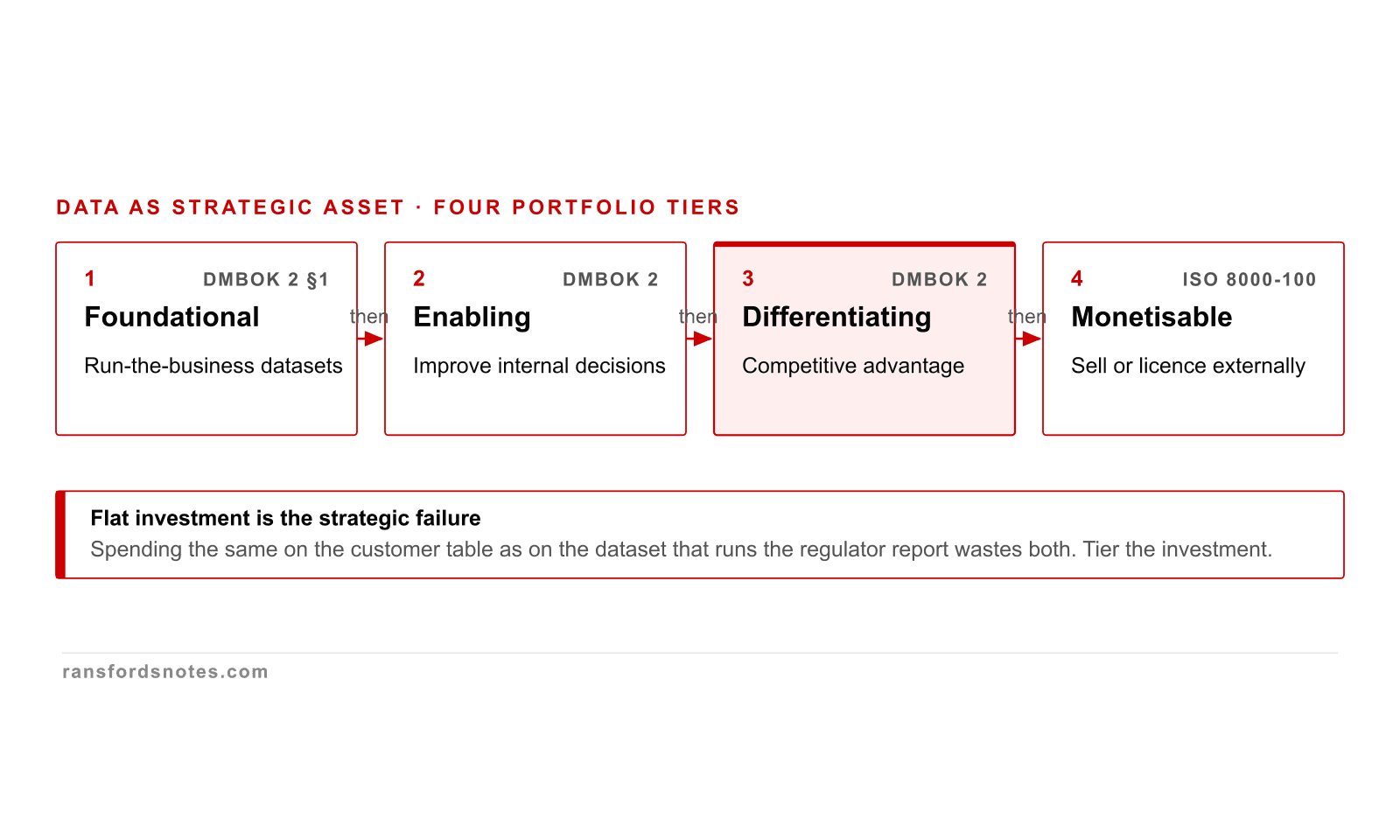
Data assets sit in four portfolio tiers: foundational, enabling, differentiating, monetisable.
Data assets sit in four portfolio tiers: foundational (run the business), enabling (improve decisions), differentiating (competitive advantage), monetisable (sell or licence). DAMA-DMBOK 2 Chapter 1 names the same four; investment should be tiered, not flat.
Four risks that change when a dataset becomes monetisable
Monetising data changes four risks: lawful basis, purpose limitation, liability, regulator scrutiny.
Monetising data changes four risks: lawful basis (new lawful-basis review), purpose limitation (new third-party purpose), liability (data quality warranty), regulator scrutiny (sector rules). UK GDPR Article 6 makes the basis review mandatory; ICO's data sharing code documents the others.
Real-world transformation · 2019 onwards
Starbucks Deep Brew: using data to predict which stores to open, three years before construction
Starbucks' Atlas system combines hundreds of data signals: population density and growth, traffic patterns, competitor proximity, neighbourhood demographic trends, income data, proximity to transit, and the historical performance of nearby Starbucks locations. Machine learning models trained on this data predict the likely revenue of a proposed new store location before a single brick is laid.
The business impact is substantial even without attaching a public number to each decision. Opening a store commits capital, lease obligations, hiring, supply chain capacity, and leadership attention. A poor location may take years to recover. A better location model does not make the decision automatic; it improves the evidence behind a capital allocation decision.
Starbucks' experience illustrates the core argument for treating data as a strategic asset: a competitor can copy store design and menu choices faster than it can copy years of location, demand, loyalty, and operational feedback data. The value is not the raw data lake. The value is the governed feedback loop that turns operating history into better future decisions.
Starbucks operates thousands of stores globally. Rather than relying only on intuition or simple demographics to choose new locations, it has used geospatial, demographic, competitive, and performance data to inform site decisions. How does treating data as a strategic asset change capital allocation decisions?
Strategy is credible only when it can be assessed. DCAM turns broad ambition into named capabilities, evidence, and maturity gaps.
26.1 The DCAM maturity framework
The Data Management Capability Assessment Model (DCAM), developed by the EDM Council, is a cross-industry framework for assessing and developing organisational data management capability. DCAM v3 was announced in June 2025 with stronger coverage of AI, cloud, governance, security, privacy, and modern pipelines. DCAM v3.1 training material presents eight core components: Data Strategy, DMS and Business Case; Data Management Program and Funding; Architecture across business, data, and technology; Business Data Knowledge; Data Quality Management; Govern Data and DMP; Data Management Operations, Risk, and Control; and Analytics Management.
A maturity assessment is not a beauty contest. It asks whether the organisation can prove how data strategy is funded, how data meaning is managed, who owns quality, which controls govern access and use, how data operations are monitored, and how analytics are connected to business decisions. A policy document without adoption evidence is not maturity. A dashboard without ownership is not maturity. A platform without quality controls is not maturity.
Evidence should be specific. A governed customer data domain should show a named owner, glossary terms, approved definitions, lineage from source systems to reports, quality rules, issue workflow, access policy, retention policy, and active usage metrics. A leadership team should be able to see whether the data asset is improving, degrading, or accumulating unmanaged risk.
The DCAM assessment process identifies capability gaps and prioritises investment. A financial services firm with strong data governance (Level 4) but weak data culture (Level 2) has a different remediation roadmap than a retail firm with strong operational data (Level 3) but weak data architecture (Level 1). The framework makes these trade-offs visible.
Maturity matters because data value is realised through repeatable decisions, products, controls, and feedback loops, not through ownership claims alone.
“effective, efficient, and acceptable use of data”
ISO/IEC 38505-1:2017 - Scope
The phrase is useful because it makes data governance a leadership duty. Effective means data supports objectives. Efficient means value is not wasted through duplication and rework. Acceptable means use remains lawful, ethical, secure, and trusted.
26.2 Data monetisation patterns and valuation
Data monetisation takes three forms. Direct monetisation sells data or data products to external parties: weather companies selling historical data to insurers, financial data providers selling market feeds to hedge funds, credit bureaus selling risk scores to lenders. This requires careful legal due diligence on consent, data sharing agreements, and regulatory permissions.
Indirect monetisation improves internal decisions and products using data without directly selling it. Recommender systems improve product discovery; pricing models improve margin decisions; demand forecasts improve stock positioning; customer analytics improve retention. The data is not sold. It changes the quality, timing, or economics of decisions.
Risk reduction monetisation uses data to avoid losses: insurance fraud detection, credit default prediction, cybersecurity anomaly detection, quality control, safety monitoring, and predictive maintenance. The value is the expected loss avoided, adjusted for false positives, false negatives, control cost, and any customer or regulatory harm created by the intervention.
Valuing data as an asset is methodologically challenging because data has no standard accounting treatment (it does not appear on balance sheets in most jurisdictions). Three approaches exist: cost approach (what did it cost to collect and maintain?), market approach (what would comparable data sell for?), and income approach (what revenue or cost saving does it generate?). The income approach is most useful for strategic decision-making but requires attributing revenue or savings to specific data assets, which requires instrumentation.
Value claims become credible only when people can interpret the evidence and when strategy metrics connect activity to outcomes.
Common misconception
“Data strategy is primarily a technology problem: buy the right platform and data management will follow.”
Technology is necessary but insufficient. A first-class lakehouse populated by data that no one owns, defines, tests, or trusts produces little value. The operating model must define decision rights, funding, ownership, literacy, quality controls, incident response, and benefits measurement. The platform enables the strategy; it does not replace it.
Common misconception
“If we collect enough data, insights will emerge naturally.”
Data volume without curation produces noise, not insight. Strategic value comes from data with clear purpose, accountable ownership, known quality, usable metadata, lawful access, and a decision process ready to act on the evidence.
26.3 Data literacy and measuring data strategy success
Data literacy is the organisational ability to read, work with, analyse, communicate, and challenge data. Without it, dashboards go unread, models produce outputs that decision-makers distrust, and data products are built for analysts rather than for the people who need to act on evidence.
The programme should be one path for every learner. Everyone starts with definitions, quality, uncertainty, and ethical use. Everyone then learns modelling, pipelines, databases, analytics, governance, and strategy. The difference is not the path; it is the examples each learner brings. A board member still needs to understand base rates before approving a fraud model. An engineer still needs to understand capital allocation before designing a data product.
Measuring data strategy success requires a hierarchy of metrics. Input metrics measure programme activity: number of data products in the catalogue, percentage of datasets with documented ownership, number of staff completing data literacy training. Process metrics measure governance effectiveness: data quality scores by domain, percentage of pipelines with SLAs, mean time to resolve data quality incidents. Outcome metrics measure business impact: revenue attributable to data-driven decisions, cost reduction from predictive maintenance, reduction in compliance incidents.
The Chief Data Officer role succeeds when it can connect data work to decisions the organisation already values. A CDO should be able to show which business outcome is constrained by poor data, which data asset will change that outcome, who owns it, what control is missing, what investment is needed, and how success will be measured after release.
A DCAM v3.1 assessment finds that an organisation's governance processes score as defined, but Business Data Knowledge and Data Management Operations are still ad hoc. What does this gap most likely indicate, and what should the CDO prioritise?
A logistics company processes 2 million parcel tracking events per day and has 15 years of historical delivery data. An insurance company approaches them to purchase anonymised on-time delivery performance data by postcode for pricing commercial delivery insurance. Which data monetisation pattern does this represent, and what must the logistics company verify before proceeding?
A CDO presents a data strategy review to the board. They show: 200 datasets onboarded to the catalogue (input metric), 78% of datasets with quality scores above threshold (process metric), but cannot quantify the business impact. The board asks: 'How much value has this programme generated?' What is the CDO's fundamental measurement gap, and how should it be addressed?
Core checks before moving on
- DCAM v3/v3.1 frames data maturity through strategy, funding, architecture, business data knowledge, quality, governance, operations risk and control, and analytics management.
- Data value appears through direct monetisation, indirect decision improvement, and risk reduction. Each route needs lawful use, ownership, quality evidence, and benefits attribution.
- A data strategy is an operating model, not a platform purchase. It defines decision rights, funding, stewardship, literacy, controls, and outcome measures.
- A single learning path is stronger than audience tracks: leaders and engineers need the same concepts, then apply them to different decisions.
- A board-ready data strategy shows input metrics, process metrics, and outcome metrics so investment can be defended with evidence.
Standards and sources cited in this module
EDM Council: announcing DCAM v3
Official announcement of DCAM v3, including enhanced AI, cloud, governance, security, and Business Data Knowledge coverage.
EDM Council: DCAM v3.1 training components
Official EDM Council listing of the eight DCAM v3.1 core components and updated training structure.
DAMA: DMBOK 2.0 Revised Edition
Current DAMA position that the 2024 DMBOK 2.0 revision is a maintenance release while DMBOK 3.0 remains in development.
ISO/IEC 38505-1:2017 Governance of data
Governance standard applying ISO/IEC 38500 principles to the effective, efficient, and acceptable use of data.
ISO/IEC 25642:2025 Data governance
Current ISO data governance collaboration framework for leaders building new digital solutions with granular data controls.
Widely used industry source for data literacy framing around reading, working with, analysing, and communicating with data.
Thomas Redman, 'Data Quality: The Field Guide' (2001)
Foundation text for data quality measurement and the cost of poor data quality. Source for the principle that data quality is a management problem, not a technology problem.
Esri ArcWatch: Going Big with GIS
Context for Starbucks using GIS and location intelligence in store and product placement decisions.
Module 26 of 26 · Practice & Strategy · Course complete